Total Pageviews

Friday, July 15, 2011

Shinn Estate Vineyards


Last week I finally made it to the tasting room at Shinn Estate Vineyards - a winery I’ve been hoping to visit for quite some time - and I am so glad I did.  The comfortable atmosphere of Shinn’s tasting room is perfect for sampling their lovely, delicious wines, and I was quite impressed with the wines.  It was also refreshing to learn about Shinn’s grape-growing practices; their approach is so natural.  This not only is important in terms of treating the land and produce with respect and care - it also allows the taster to experience fully the natural aromas and flavors of the grape types in the wines.  Shinn’s wines define “natural.”


We opened with the 2010 “First Fruit” Sauvignon Blanc, a pale, crisp, clean wine very indicative of its grape varietal, with white citrus, orchard fruit, white blossom, herbal notes, and a hint of tropical fruit, and bright acidity to cleanse the palate and accompany local Long Island seafood, followed by a long finish.  This wine is elegant yet unpretentious, very food friendly, and so enjoyable.
The 2007 Brut Sparkling Blanc de Blancs is 100% Chardonnay.  The wine is a light golden color with aromas of white and green fruit, green apple, baked bread, and hints of tart citrus and nut, and the flavors confirmed the aromas.  I loved the bubbly yet creamy and smooth texture of this sparkling wine.
Next was the 2009 “Haven” Sauvignon Blanc Semillon, a lovely white Bordeaux style blend that is pale yellow/gold in color, and shows aromas of light citrus and grapefruit, pear, white blossoms, and a hint of spice and oak, imparting beautiful aromas and flavors and adding complexity to the wine.  The citrus was confirmed on the palate, as well as a bit more emphasis on orchard fruits, and some gentle spice, good balance with bright acidity, and a long finish.


We then moved on to the 2009 Pinot Blanc, a yellow/gold wine with aromas of bright lemon, orchard fruit (especially pear), and a hint of stoniness, and these characteristics were confirmed on the palate with lots of lemony acidity softened a bit by the notes of pear, followed by a long finish.  This wine has a great deal of character and presence and I enjoyed it very much.
One of my favorites of the tasting was the 2010 Rose, a blend of Cabernet Franc and Merlot.  This is a very dry rose, making it particularly food friendly, and it displays characteristics of watermelon, strawberry, a hint of raspberry, and a bit of unique freshness both on the nose and the palate.  The wine is extremely clean and excellently structured, with a long finish.  I absolutely adored this rose and would love to taste it again.  I have tasted a lot of rose wines this summer and Shinn’s 2010 Rose ranks among my favorites.
Next was the 2010 Chardonnay, which reminded me a bit of Chablis, due to its light color, bright citrus and soft orchard fruit characteristics, and gentle spice, upbeat acidity and nice balance, and a long finish leaving the palate feeling very clean.  This is another wine that would pair particularly well with fresh local seafood.
We then moved on to the reds, beginning with the NV “Red,” a non-vintage blend of Merlot, Cabernet Franc, and Syrah.  I loved the bit of wildness introduced to the wine with that Syrah blended in - it gives the wine such character.  The wine is full of fascinating notes of both red and dark fruit, berries, plum, tart cherry, earth, and spice.  I think this wine is quite food friendly but also seems to work well on its own.
Next was the 2008 Estate Merlot, which has just 5% Malbec blended in.  This wine is excellent and I enjoyed it very much.  It is ruby colored, and shows characteristics of plum and berry, both dark and red fruit, and lots of baking spice and vanilla.  I think this was the most sophisticated wine I tasted at Shinn and I would love to have this wine again.


I was fascinated with the 2008 “Wild Boar Doe,” a Meritage blend of Bordeaux varietals such as Merlot, Cabernet Sauvignon, Malbec, Petit Verdot, and Cabernet Franc.  The wine is very dark in color, and dark in aroma and flavor with notes of dark fruit and deep spice, and a nice balance of acidity and firm tannins.  I loved the depth and complexity of this wine and I think it would be ideal for the cooler months and for pairing with meats.
We finished with the 2007 Malbec, a very dark wine, almost a blackish purple, that showed characteristics very indicative of Malbec - blueberry, soft floral aromas, earth, and dark chocolate, with just a bit of spice.  This beautiful example of Malbec was a wonderful finish to the tasting.
One wine that instantly made me smile that we had early in the tasting was the 2010 Wickham’s Pear Cider, made of different pear varieties, the flavor is that of pure soft fresh pear, easy on the nose and the palate, and perfect for sipping on the porch in the warmer months.


So the next time you’re out tasting wines on Long Island’s North Fork, be sure to visit David and Barbara at Shinn Estate Vineyards and enjoy their excellent wines.


Friday, July 8, 2011

Macari Vineyards


Yesterday I had the pleasure of visiting Macari Vineyards, a beautiful winery located in Mattituck (North Fork of Long Island).  I visited Macari a few years back and enjoyed my time there, and this visit was also a wonderful experience.  The vineyard and tasting room are lovely and the wines are excellent quality, and the winery prides itself also on its knowledgeable and friendly staff.


Gibson began the tasting with the 2010 Sauvignon Blanc, a new release from what appears to be an extraordinary year for Long Island wines, due to weather conditions during the ripening season.  The wine is a very pale straw color with hardly any water rim, indicating its youth.  The aromas are very indicative of the varietal, with lively citrus, green apple, peach, white flowers, and grassy notes.  The flavors were a bit more tart than the aromas would indicate, including grapefruit, and hints of peach, herb, and good minerality.  The wine shows bright acidity and excellent balance, a crisp clean texture, and a long finish.


Next was the Collina 48 Chardonnay, a nonvintage blend of 2008 and 2009.  This is a very pale Chardonnay with a bit of Sauvignon Blanc in the blend, with a faint water rim and modest alcohol.  The aromas are indicative of Chardonnay, including lemon zest, red apple, pear, and stony soil.  The flavors are more crisp, including bright citrus and green apple.  The wine is smooth and very enjoyable and very reasonably priced as well.

2010 Sauvignon Blanc and Collina 48 Chardonnay

We then moved on to the 2007 Estate Chardonnay.  The wine is straw colored but not quite so pale as the first Chardonnay.  The characteristics included tangerine and a hint of lemon and white fruit, and interestingly, a bit of fig.  The flavors confirmed the aromas, but also showed tropical fruit, with lots of bright acidity and a long, clean finish.

2007 Estate Chardonnay and 2007 Reserve Chardonnay

Next was the 2007 Reserve Chardonnay, which spent time in contact with French oak and it was evident as soon as I observed the wine in the glass - it is a yellowish color with a clear rim, and the aromas include white citrus, baked apple and pear, ginger, baking spice, and a hint of bacon fat.  The flavors confirmed the aromas and added a bit of earthiness, as well as tropical fruit and pineapple, and yeasty bread flavors, yet the wine is so clean and crisp, particularly on the finish - the palate feels so clean.  This wine seems as though it would be especially nice to pair with local seafood.
I then tasted the 2010 Riesling.  The grapes are not from Long Island - rather, they are from the Finger Lakes region, but the wine is produced by Macari.  Regarding appearance, the wine is a light straw color, and after swirling and noting the viscosity of the wine, it was clear that this Riesling has a higher alcohol content than a typical German Riesling.  The aromas include apricot, peach, white blossom, and underlying lime and pink grapefruit, and the flavors confirmed the aromas, with a balance of sweeter fruit flavors and racy acidity.  The wine is so easy on the palate and has a soft and lovely finish, and I really enjoyed this wine.

2010 Riesling

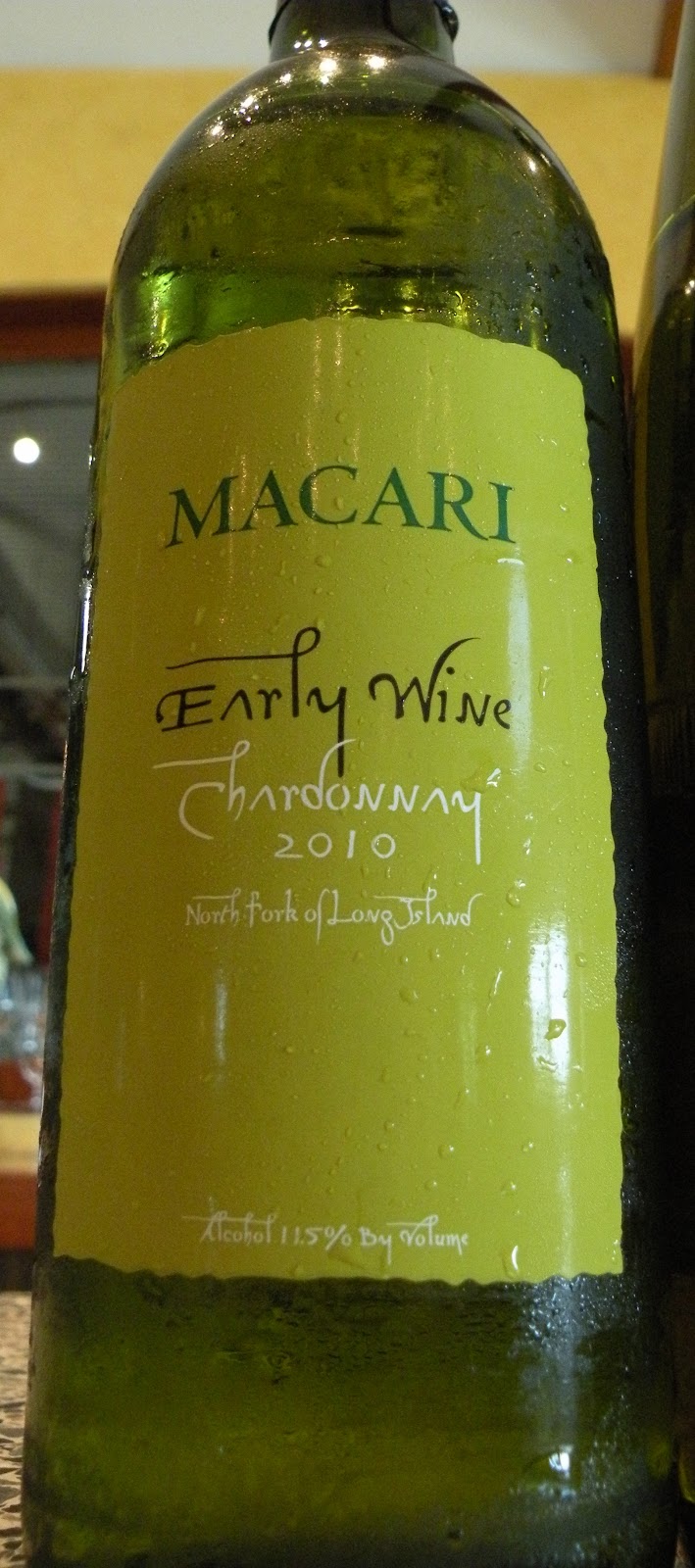
We then went back for one more Chardonnay, the 2010 “Early Wine,” which is a wine made of Chardonnay grapes picked early and sent through production to bottling very quickly.  The color is extremely pale, with characteristics of youthfulness, light citrus, melon, green apple, and white flowers, with a bit of tropical fruit on the palate, but overall the wine has very green and bright characteristics.  I liked the refreshing uniqueness coupled with the nice balance and acidity, and the very long finish.

2010 Early Wine Chardonnay

Rose is so popular this year and Macari’s 2010 Rose certainly didn’t disappoint.  It is a blend of mostly Merlot and other Bordeaux varietals, and has a beautiful salmon pink color.  The aromas include cherry (but not sour), strawberry, a hint of watermelon, and a bit of herb and stony soil.  The flavors were reminiscent of tart cherry, strawberry, and fresh watermelon, and the wine shows bright acidity and a happy sort of personality with a long finish and lovely balance.  I really enjoyed this wine very much, I believe it is quite food friendly and I look forward to its release so I can enjoy it again.

2010 Rose

And then it was time to move on to the reds.  First was the 2008 Cabernet Franc, a ruby colored wine that showed notes of berry and plum laced with smoke, spice, earth, and just a touch of oak.  Cabernet Franc is a very successfully grown grape on Long Island, and Macari’s Cabernet Franc is an excellent representation of the varietal, with its excellent balance of acidity and tannin, followed by its long finish - I loved the structure and texture of this wine.

2008 Cabernet Franc

The next red was the Sette, a nonvintage wine of about half Merlot and half Cabernet Franc, probably the two most important red grapes on Long Island.  The wine shows an Italian influence, as intended by Macari, and while I observed the ruby colored wine, the aromas leapt out of the glass to reveal a nose of both red and dark berries and fruits and fascinating spices and wood, with a warm earthiness about it.  The flavors confirmed the fruit and spice, with excellent structure and a lingering finish.  I think this is an ideal wine for the cooler months and would make a lovely pairing with meats and Italian cuisine, and as Gibson mentioned, it’s a wine perfect for enjoying by the fireplace.

Sette

We then moved on to the 2005 Merlot Reserve, which is beginning to show some age as the color is turning from red to a brick hue, and the wine’s age was evident in its fascinating complexity, with unique aromas of dark fruit, mushroom, damp earth, and a hint of spice and wood.  The flavors were very indicative of a good Merlot, including more red fruit than the aromas showed, a French sort of influence in the earthy quality, good acidity and firm tannins, and a very long and lovely finish.  This wine I would probably pair with steak or slow-cooked meats.

2005 Merlot Reserve

Next was the 2007 Bergen Road, a “Macari favorite” and for good reason - this Meritage type wine (a sort of Bordeaux blend often done very nicely at several Long Island wineries) is complex and elegant.  A deep ruby with a red-pink rim, the wine stains the glass with its intensity, and opens into aromas of seductive dark fruit and red fruit, smoke, deep spice, a bit of earth, chocolate, and wood, and lots of fruit and spice on the palate, with excellent structure and balance, a luscious texture, and a long finish.  I would love to try this wine again in a few years and see how it has developed; this wine is stunning and very impressive.

2007 Bergen Road and 2008 Dos Aguas

The last red was the 2008 Dos Aguas, another Meritage, very dark with a color similar to Malbec, deep purple with a pinkish rim indicating its youthfulness.  The aromas were of dark fruit, stewed berries, plum, and spice, and the flavors confirmed the aromas, with a bit more emphasis on the spice.  Another nicely balanced wine with a long finish, this wine would pair nicely with meats.
Finally, it was time for the 2008 Block E, Macari’s lovely dessert wine of Viognier and Pinot Gris.  The wine is a golden color, not overly viscous, with aromas of apricot, stone, honey, and a vegetal note, and flavors of apricot, peach, tropical fruit, and honey.  The wine is soft and smooth, and remarkably light for a dessert wine, significantly lighter in density than a Sauternes, for example.  I feel this dessert wine is food friendly in that it could also be paired with spicy cuisine, including Asian dishes, and not just dessert wine - or it could be paired with desserts, or enjoyed as a dessert on its own.  I have always enjoyed Block E and the 2008 is as wonderful as I remembered previous vintages.

2008 Block E

I wrapped up my visit to Macari with a lovely conversation with Mr. Macari.  I had a wonderful time at their tasting room and am looking forward to my next trip there, the wines are fantastic and Macari ranks among my favorite wineries on Long Island for their consistent good quality, beautiful vineyards and tasting room, and pleasant and knowledgeable staff.  So the next time you’re visiting Long Island’s wineries, be sure to stop in at Macari’s tasting room.


Friday, July 1, 2011

Appreciation for German Rieslings

Riesling has left me scratching my head a number of times over the years.  So many people use Riesling as their gateway or training wheels to drinking wine, and while I do realize it has those sweeter, fruity characteristics that tend to somewhat mask its radiance and acidity, I think most people who start with Riesling tend to underestimate the varietal.  Riesling isn’t just an entry level wine the way white Zinfandel is.
I knew a guy several years back, and one day he and I were discussing wine.  He was dark and handsome and very Southern Italian, and I was figuring him for the Super Tuscan type, and then he told me he really just drinks Riesling.  Now, drinking Riesling isn’t something to be ashamed of - it’s something to be proud of and happy about.  But it sounded as if he had just told me he drinks only white Zinfandel.  Riesling is not a set of training wheels, and while it’s a fairly easy wine to break in on, I think for that reason many new wine drinkers assume it’s nowhere near as special as Cabernet or Pinot Noir, for example.  Not so.
Riesling is a white grape native to the Rhine area of Germany and dates back somewhere between 500 and 600 years ago.  Over the years, Riesling has been planted elsewhere, including Alsace (France), Austria, United States (most notably in the Finger Lakes region of New York), Canada, Australia, and some other areas as well, and it tends to grow best in cooler areas.
I’ve tried Rieslings from several regions and have enjoyed most Rieslings I’ve tasted, but my favorites are often from Mosel, Germany.  In Mosel, producers tend to be purists, and the Rieslings are rarely blended with other grapes, rarely exposed to new oak barrels, and rarely treated with commercial yeast.  For those reasons, Mosel Riesling is especially indicative of its cool terroir and stony soil, and its true characteristics are able to come through to the nose and palate of the drinker.  Karen MacNeil (in The Wine Bible) goes so far as to describe the pure Mosel Riesling as seemingly “naked” and “transparent.”

Mosel Riesling with sesame seared tuna and avocado, with a sauce of lime, soy, honey, and wasabi - Riesling is generally very food friendly

Riesling, particularly from Mosel’s steep slopes, is often very pale in color and light in texture with characteristics of citrus (most notably lime), tropical fruits, bright green apple, blossoms, and of course mineral.  So many people think of Riesling as a sweet wine, but in fact it has very high acidity and is very nicely balanced, making it especially food friendly with lighter dishes as well as spicy Asian cuisine.  And as strange as it may sound, one of the things I like most about the German Rieslings I’ve tasted is that many are very low in alcohol content, making them so refreshing and easy on the palate.  Lots of Rieslings should be enjoyed while young in order to experience the fruit and floral characteristics, but Riesling also has great aging potential, particularly the sweeter Rieslings (but watch out for the petrol notes that tend to surface in older Rieslings).
Other German regions are increasing their production of Riesling as well, particularly Rheinhessen, which has generally concentrated on Muller-Thurgau over the years.
My “everyday” Riesling is the Doctor Loosen “Dr. L” Mosel Riesling, a very dependable and consistently good pale colored, light Riesling with characteristics of lime, peach, and a hint of something tropical in its fruitiness, with just a bit of spice.  The wine initially appears a bit sweet, but the acidity comes through and cleanses the palate, making this wine extremely food friendly.  I’ve tasted it with pork, seafood, chicken, turkey, lighter cheeses, spicy Thai food, and even on its own, and I’ve enjoyed it every time - and it’s a good bargain as well, at only about $10.

2008 Doctor Loosen “Dr. L” Mosel Riesling

A somewhat more textured and less dry Riesling I recently tried is the Fritz Windisch Selzer Osterberg Riesling Auslese from the Rheinhessen region.  A bit more golden in color than most Mosel Rieslings I’ve tried, this wine still has the citrus notes, but has greater emphasis on orchard fruit characteristics such as peach and apricot, and still has the floral aromas but leans a bit toward honey sweetness instead of the lighter floral characteristics.  This wine would be especially well suited for spicy Asian foods.

2009 Fritz Windisch Selzer Osterberg Riesling Auslese (Rheinhessen)

The most recent Riesling I’ve tried is the St. Urbans-Hof Mosel Riesling; this wine defines transparency, with its pale color, and fresh lime and peach characteristics and floral notes with a hint of spice and lots of minerality.  It is a perfect reflection of its Mosel terroir with a balance of sweeter fruit and racy acidity, leaving the palate perfectly cleansed.  This wine is very food friendly and so sophisticated and elegant, I was very impressed with this Riesling.

2009 St. Urbans-Hof Mosel Riesling

Due to the complexity and beauty of Rieslings as well as their aging potential, not to mention the work that goes into producing it (the slopes in Mosel are so incredibly steep, and the producers do all that they can to maintain the purity and integrity of the wine), I would hope that so many new wine drinkers stop using Riesling as their training wheels and eventually come to appreciate the wine for what it is.

Thursday, June 23, 2011

Riedel Wine Glass Tasting at Morton’s The Steakhouse

This week I had the pleasure of attending a presentation of Riedel wine glasses including a tasting of several wines, at Morton’s the Steakhouse in Manhattan.  The purpose of the tasting and presentation was to demonstrate how the use of a proper wine glass enhances the experience of drinking each particular wine.
Many people are skeptical of whether the shape or quality of the wine glass has any effect on the appearance, aroma, and flavor of the wine - in fact, the Riedel representative posed the question to the people in attendance as to whether they were at all skeptical about how a glass effects the overall wine experience.  But after a very short amount of time, it was clear that a good quality and properly shaped wine glass indeed affects the wine experience.

Riedel Wine Glass Tasting at Morton’s The Steakhouse

Since a tasting should begin with the lightest wine of the evening, the first wine we tasted was the Chateau Ste. Michelle Horse Heaven Vineyard Sauvignon Blanc, and the glass was the Riedel Vinum Sauvignon Blanc.  The glass is egg shaped and the top is a bit tapered, so that the aromas typical of Sauvignon Blanc - light fruits and flowers - are enhanced, and the wine is directed to the front of the tongue and palate, which makes the flavors and bright acidity characteristic of Sauvignon Blanc become more apparent.
We were also asked to sample the same Sauvignon Blanc from the “joker” glass, a small plastic cup which completely detracted from the aromas, and over-emphasized the acidity.  Clearly, a plastic cup is not suited for drinking good wine, or any wine for that matter.  I think that much was clear before we even began the tasting, but after analyzing the Sauvignon Blanc in its proper glass and experiencing all of the aromas and flavors one would expect from the varietal, one could already be persuaded to invest in appropriate Riedel glasses for a variety of wines.  And there were still three more wines to try, in three different glasses.
The next wine was the Chateau Ste. Michelle Canoe Ridge Estate Chardonnay, a white with more body than the Sauvignon Blanc.  The wine was served in the Riedel Vinum Chardonnay Montrachet glass, with a large bowl and a very wide rim, best suited for accentuating the wine’s fuller and more intense characteristics, including the buttery, rich, caramelized notes of the Chateau Ste. Michelle Chardonnay.  Had the Chardonnay been tasted from the narrower, egg-shaped glass, the full bodied wine would have lost its rich character.
We then moved on to the reds, the first of which was the Villa Maria Cellar Selection
Pinot Noir, with fruit characteristics and gentle tannins.  The glass was the Riedel Vinum Pinot Noir Red Burgundy, with a large bowl perfect for bringing out the Pinot Noir’s fruity aromas, and the tapered rim aiming the wine at the front of the tongue to perceive the sweeter characteristics of the wine and softening the perception of acid, making for a proper balance in the flavors and textures.  If the wine were tasted from a glass that looks similar (the Montrachet glass) but without the tapered rim, the aromas will be preserved, but the flavors will be misdirected, causing the wine to display too much acidity, and masking the fruit flavors characteristic of Pinot Noir - clearly the Pinot Noir must be tasted in a glass with the large bowl, but with the narrower rim.
The final wine of the tasting event was the Chateau Ste. Michelle Cold Creek Vineyard Cabernet Sauvignon, a tannic, full bodied red with notes of dark fruits.  The glass was the Riedel Vinum Cabernet Sauvignon/Merlot, with a deep bowl ideal for bringing out the many layers of aromas in Bordeaux varietals, that tapers to a narrower rim, again directing the wine to the areas of the mouth that detect sweetness, allowing the wine to show its fruit, instead of only displaying the tannins.
After tasting the wines in the Riedel glasses for which they were intended, it was clear that a wine enthusiast hoping to maximize the experience of the wines should invest in good quality, properly shaped glasses.  The hosts of the event were so gracious as to send their guests home with a set of complimentary Riedel glasses, one of each of the glasses we used during the tasting.  My glasses of choice are Riedel, and the glasses of the Vinum collection are relatively affordable - it is certainly worth investing in these glasses to better enjoy your wine experiences.

Riedel


Friday, June 17, 2011

Fantastic Wines on a Night to Remember

This weekend marks a year since my sister and brother-in-law got married.  I can honestly say that night was one of the most fun nights of my entire life, we had such a wonderful time and it’s hard to decide what stood out the most from that wedding, the music, the food, the wine, the overall atmosphere, the fun we had with family and friends, and seeing Lauren and Mike so happy on their wedding day, it was such a special memory we will have forever.
I think a lot of people underestimate the importance of excellent food and wine at a wedding.  When choosing a venue for the wedding, Lauren, Mike, and my parents considered many locations, but when they visited the Garden City Hotel (Garden City, Long Island, New York) and met with Joseph Borbely, their director of catering, they knew instantly that they had found the perfect venue.  The food was excellent, cocktail hour consisted of so many stations including a sushi station, raw bar, Peking duck, and lots of others.  Appetizer was a lobster sampler, the salad was field greens with apple chutney, and dinner was a choice of swordfish or filet mignon, followed by a gorgeous and delicious wedding cake.  But when preparing for the wedding, when Lauren chose the menu, she had to decide which wines would be served.  And her choices were perfect; they were the best wines I’ve ever had at a wedding.  We were told by guests how much they enjoyed the food and wine, and some even sipped Champagne throughout the evening.  We were so happy to hear how much everyone enjoyed the selections.
The Champagne, served throughout the reception, was the Moet & Chandon Brut Imperial NV.  This is such a dependable Champagne that has lovely characteristics of light crisp citrus, a hint of white flowers, nut, brioche, and just an indication of honey on the finish.  While sparkling wines, including Champagne, are very food-friendly and excellent palate cleansers due to their bubbly texture, this Champagne was actually an ideal pairing with the salad and apple chutney, and accompanied the lobster sampler very nicely as well.  In addition, it’s an excellent choice for cocktail hour, as there are so many different flavors and small plates, and it’s not easy to find a red or white to pair with all of what is offered at each station.  The shining moment for the Champagne on that evening was during the toast, I was so honored to raise a glass of Moet & Chandon to the happiness of my sister and brother-in-law at the end of my maid of honor speech.

Moet & Chandon Brut Imperial NV

One of Lauren’s favorite white grape varietals is Sauvignon Blanc - it’s crisp, clean, complex, and relatively easy to pair.  To accompany the lighter dishes, as well as the lobster sampler and the swordfish, she chose the 2008 Domaine Alain Cailbourdin Pouilly-Fume Les Cris.  This is a Sauvignon Blanc from the Loire, and it is very indicative of its region, very pale in color, with energetic notes of bright citrus, white fruit, grassy herbs, and mineral characteristics, very upbeat yet classy and elegant, beautifully structured with bright acidity, and a long finish.

2008 Domaine Alain Cailbourdin Pouilly-Fume Les Cris

After considering a Medoc and a Hermitage, Lauren opted for the 2006 Domaine de l’Harmas Chateauneuf du Pape, which was an excellent pairing with the filet mignon.  The wine, consisting of Grenache and Mourvedre, is a deep dark red Southern Rhone blend, with characteristics of dark and red fruits and berries, tobacco and a bit of smokiness, earth, a complex spiciness, and perhaps an indication of dry potpourri.  The wine is nicely balanced with a bit of sweet fruit, tartness, and a dry texture.

2006 Domaine de l’Harmas Chateauneuf du Pape

Often, it’s best to ask a catering director about upgrading the wines at an event as important as a wedding, as a facility is unlikely to offer its best selections as house wines.  Good food and wines are no less important than a beautiful dress, lovely flowers, and excellent music at an important event, and you and your guests would notice the difference.
Wishing a very happy first anniversary to Lauren and Mike!

Friday, June 10, 2011

Refreshing Whites for Summer Evenings

Last night we had a thunderstorm, much like any summer storm, the kind that knocks out the electricity for a few hours.  It’s a hot night, the air conditioner goes off - hopefully you’ve got your bottles stored in a place where they’ll keep cool until the house is cool again.  But what do you drink to keep yourself cool?  Probably something chilled and crisp - that would be my choice.
Last night was a Pinot Grigio.  I usually steer clear of the celebrity wines, but I was curious to try the Ramona Singer Pinot Grigio - and it didn’t disappoint.  Pale straw in color with characteristics of lemon, white flowers, fresh cut grass, and a hint of nut, bright acidity, and a long finish, this wine is a good yet inexpensive example of a food-friendly Italian Pinot Grigio.  I was pleasantly surprised and would go for it again.

2010 Ramona Singer Delle Venezie Pinot Grigio

Another summer wine at a very reasonable price is The Crossings Sauvignon Blanc from Marlborough, New Zealand.  I loved this wine the first time I tried it and keep a bottle in my wine rack at all times - it’s such a dependable Sauvignon Blanc and so indicative of its region.  Very pale in color with notes of tropical exotic fruits, bright citrus, soft herbal characteristics, and good minerality with upbeat acidity and a clean finish, this is another food-friendly wine perfect for very warm weather.

2009 The Crossings Marlborough Sauvignon Blanc

When thinking of Riesling, often we think of a wine with a sweeter taste, however that sweetness is actually softening a very bright acidity typical of a good Riesling, and that underlying acidity is exactly what makes Riesling such an ideal summer wine.  One of my all-time favorite Rieslings is the Pierre Sparr Alsace Riesling.  The wine is straw colored but leaning towards golden, with characteristics of lime and a bit of sweeter citrus, white blossoms, and a hint of spice, with that clean Riesling acidity and a very beautiful finish.  Food-friendly though it is, my preference is to enjoy this wine on its own.

2005 Pierre Sparr Alsace Riesling


Friday, June 3, 2011

The “Wow Factor"

I do enjoy my regular favorites and there are lots of wines that keep me coming back for more, but I continue to try new wines to keep an open mind, keep on learning, and occasionally stumble upon something truly amazing.  Every so often, I get a surprise when I open a bottle that I figured would be satisfying, and the wine far exceeds my expectations.  These wines have what I call the “wow factor” - they’ve got that certain something about them that makes them special.
A white that very recently surprised me was the 2004 Tamellini Soave, produced in the Veneto region of Italy from the Garanega grape.  Generally, a Soave is meant to be enjoyed fairly soon after production, so you’re probably wondering why I had the 2004 Soave in 2011.  My explanation is that it was the only bottle of Soave I could find, and when I held the bottle up to the light, it looked clear, so I decided to bring that bottle home.  It’s a bright yellow color with a pale straw, almost clear rim, and characteristics of citrus, apple, a hint of peach, and lots of floral notes, a coolness about it, and a long finish with interesting notes of nut and cheese.  I paired the Soave with Italian feta cheese, and spinach fettuccine with sauteed chicken and a light cream sauce, and the wine worked very nicely with this dinner.

2004 Tamellini Soave


I had expected the wine to be perhaps past its prime since Soave should be enjoyed very young, but instead, it had matured gracefully, and the many layers of aromas and flavors, with its present yet somewhat restrained acidity and lovely structure and lengthy finish, gave me a very happy surprise, and as I allowed the wine to return to room temperature, the flavors were absolutely bursting and I could not have been happier with it.  The wine was truly wonderful, at a very reasonable price.

Soave with spinach fettuccine and sauteed chicken in a light cream sauce

A few weeks back while blind tasting, I found that maybe it was time to explore some South American wines, and what better way then to start with a good Malbec?  The answer is to start with an amazing Malbec!

2004 Achaval Ferrer Malbec

I picked out a bottle of 2004 Achaval Ferrer from the very dependable Mendoza region in Argentina to pair with the steak I had rubbed with fresh garlic, and a baby mesclun salad with a balsamic vinaigrette.  As soon as I poured the wine, I knew for sure it was something special.  Very dark in color with a much lighter rim demonstrating its age, and plenty of viscosity in the glass indicating its alcohol content, the aromas rushed to me in the form of rich blueberry, blackberry, plum, a hint of purple flowers (perhaps violets or lilacs), soft herbs and baking spices.  The aromas were confirmed on the palate, with the blueberry characteristics really coming through, with that bit of spice and mineral soil characteristics.  The tannins had softened beautifully and balanced so nicely with modest acidity, and the finish seemed to go on forever.

Malbec with steak and mesclun salad

It’s safe to say I was very taken by this wine and this is one of my best examples of the “wow factor” - I figured this would be a good wine since it was one of the higher priced Malbecs in the wine shop that day and something made me confident with the purchase, but I had no idea how much I’d love this wine.  I’ve heard the recent vintages of Achaval Ferrer Malbec are very enjoyable as well, and I look forward to tasting them.