Total Pageviews

Friday, August 5, 2011

My Virginia Wine Excursion

A few weeks ago on my way home to New York after visiting my sister and brother-in-law in Virginia, I decided to stop at a couple of Virginia wineries after hearing conflicting opinions about Virginia wines.


The first winery I stopped at was Lost Creek Winery in Leesburg.  The tasting room is beautiful and I was pretty curious to try the wines.
First was the 2010 Chardonnay, a pale yellow wine with characteristics of citrus, apple, and a bit of stoniness, bright acidity, and a crisp, clean feel.  The wine seemed very food friendly and I liked it.


Next was the 2010 Spring Time, a blend of Vidal, Viognier, Chardonnay, and Muscat Canelli.  This was another pale straw colored wine, with notes of slightly sweet citrus, orchard fruit, and a caramelized characteristic and a bit of macerated fruit.  On the palate, it is a bit tart, and far less sweet than the aromas would indicate, and the finish was quite long.
The third wine I enjoyed - it was the 2010 Vidal Blanc, light colored with lemon, orchard fruit (including apple, pear, and peach), and white blossom characteristics.  On the palate it is just slightly sweet with nice acidity and a clean finish.
Next was the 2010 Sweet Summer, a blend of Vidal, Chardonnay, and apple.  I really wasn’t connecting with this wine - it has a hint of citrus with lots of tart apple, raisin, and baking spice characteristics, but the apple and something almost indescribable overpowered the other aromas and flavors.  In my opinion, the wine was not at all food friendly, and the flavors seemed to be fighting with each other a bit.


We then moved on to the Rose, a blend of Cabernet Sauvignon, Merlot, and Chardonnay, and the wine is salmon pink in color.  The wine has aromas of very light, under-ripe strawberry and raspberry, and both sweet and tart characteristics, laced with a bit of fresh cut grass.  Considering the wine seemed so light on the nose and on the palate, I liked the structure very much, with bright acidity and a long finish.  I think it would be quite food friendly.
It was then time for the reds, and first was the 2009 Chambourcin.  The wine is a deep purple color, with notes of both red and dark fruit, a bit of raisin, plum, spice, and pepper.  However, I felt that the wine lacked structure, there was little texture on the palate, not much acidity, and not much finish.
The next red was the 2009 Merlot which was kind of disappointing.  It was a pale ruby red and approaching the wine I had expected regular Merlot characteristics - however, the wine had an overwhelming aroma and flavor of green bell pepper that almost completely masked the hints of dark fruit and spice that were a bit difficult to detect.


I then tried the 2009 Reserve, a blend of Cabernet Sauvignon and Merlot.  This wine was better than the other reds so far - ruby colored with a very slight water rim, and notes of soft fruit and a hint of spice.  There was some bright acidity and a decent finish, and I think the wine would be pretty food friendly.
The final red was the 2009 Chambourcin Gold, and probably my least favorite of the tasting.  Deep purple, the wine had berry undertones but the prevalent aroma and flavor was reminiscent of ink, and it was difficult to extract any other aromas or flavors, and very difficult to assess the structure of the wine, as I couldn’t keep it on my palate for too long.  I was really disappointed with this wine.


Interestingly, the two dessert wines were fun and I finished the tasting on a somewhat higher note.  The first of the two dessert wines was the Courtney’s Christmas blend of Chardonnay, Vidal Blanc, Chambourcin, Merlot, and Cabernet Sauvignon.  The color was a slightly amber pink, and the aromas and flavors reflected the “Christmas” name - the wine is perfect for autumn and winter months, with characteristics of spice, clove, gingerbread, and orange spice.  This was a really fun surprise.
The final wine of the tasting was the 2010 Late Harvest Alyce (Vidal).  The wine is a light golden color, with notes of pineapple, pear, mango, and passionfruit - mostly tropical fruits.  There wasn’t much acidity and the wine wasn’t particularly well balanced but the aromas and flavors were nice.
I then visited Tarara Winery, also very beautiful and also in Leesburg.  Tarara’s tasting room is quite simple but I was immediately impressed upon hearing that only Riedel glasses are used for tasting, and I could sense that the staff is quite knowledgeable.  And I am happy to report that the wines are equally as impressive.


We began with the 2009 Charval, a blend of Chardonnay, Viognier, Sauvignon Blanc, and Pinot Gris, fermented mostly in stainless but partly in barrels.  The wine is straw colored, with notes of white citrus, green apple, and mineral, and buttery and smooth characteristics and just a hint of yeastiness, nice acidity, and a clean feel followed by a long finish.  This was an excellent start to the tasting and I was already excited to try the others.
Next was the 2010 Rose, a blend of the juices of all the reds produced by Tarara.  The color is a brickish pink, and the characteristics were those of strawberry, a hint of raspberry and cherry, soft sweet citrus, white flowers, and a bit of grassy herb, and on the palate just a bit of spice.  The wine shows bright acidity and a very long finish.  This was quite a unique Rose as it had so many layers and a personality of its own, I think it would be very food friendly and I enjoyed it very much.


We then moved on to the reds, and first was the 2008 Cabernet Franc, which was ruby colored with a slightly brickish rim.  The aromas are mostly dark fruit and berry, a bit of cherry, herb, and spice, and the flavors were complex with cherry, dark berry, herb, spice, and a bit of raisin, with slight smokiness.  The structure is excellent with a nice balance of acidity and tannin, and the smooth finish carried with it the smokiness as well as the dark fruits.
Next was the 2008 Long Bomb Edition Two, a blend of Cabernet Franc, Merlot, Cabernet Sauvignon, Tannat, Petit Verdot, Touriga Nacional, and Pinot Noir.  The color is a very deep ruby with a crimson rim, and the wine shows characteristics of dark ripe fruit, bold berry aromas and flavors, stewed fruits, a hint of dried flowers, and an almost scorched earth sort of aroma.  The structure is nice with a good balance of acidity with soft tannins, and an excellent finish.  This wine is absolutely lovely and I was really impressed with it.


We then moved on to the 2007 Long Bomb Edition One, which is a bit different as the grapes are all from the Columbia Valley in Washington State.  The wine is a blend of Cabernet Franc, Cabernet Sauvignon, and Merlot, and it has an intense, dark ruby color.  The characteristics include dark fruit and berry, plum, spice, and earthiness.  The acidity makes the wine particularly food friendly and the firm tannins gave it great balance and texture, the finish is long, and this was another fantastic wine.
The final wine of the tasting was the 2008 Nevaeh Red, an estate red blend of Merlot, Cabernet Franc, and Cabernet Sauvignon, with a ruby color and a crimson rim.  The wine is so expressive of its Virginia terroir, not only for its grape types, but also because it is aged in new Virginia oak and fermented on indigenous yeast.  The characteristics were of dark and red fruit, berry, plum, dry leaves, a floral hint, earthiness, and cedar and spice.  I loved the many layers of this wine and its complexity, plus its excellent structure of nice acidity and modest tannin, and its rich finish.  This was a particularly nice end to my day of tasting at the two Virginia wineries I visited.


Friday, July 29, 2011

Waters Crest Winery

A few months ago, I tried the 2009 Waters Crest Rose, and after enjoying it very much, I decided to visit Waters Crest Winery.  And aside from enjoying their wines, I was impressed that all tastings are done with Riedel glasses.


The first wine I tasted was the 2010 Rose, a blend of Merlot and Sauvignon Blanc, very pale pink in color, with characteristics of watermelon and strawberry, and a hint of white flowers and light citrus.  The wine is very light but shows bright acidity and a nice, long finish, and I think this is a versatile wine, which I enjoyed.
Next was the 2010 Campania Bianco, a blend of Chardonnay, Sauvignon Blanc, and Riesling.  The wine is a straw color, with notes of white citrus, apple, peach, melon, blossom, and a bit of an herbal, grassy characteristic.  On the palate, the Sauvignon Blanc is quite evident.  The texture is crisp and leaves the palate feeling clean.
I then tried the 2010 Dry Riesling, which is extremely pale straw in color, with characteristics of a dry Alsatian style Riesling - light citrus, a bit of tropical fruit, and mineral qualities, with very bright acidity.
The last white I tasted was the 2009 Reserve Chardonnay, which has characteristics indicative of the French oak in which it fermented.  It is a pale golden color, with notes of light citrus, pear, baked apple, oak, and baking spice, with a bit of honey and toast.  The texture is smooth and buttery and the finish is long.  This was probably my favorite of the whites.


We then moved on to the reds, and first was the 2007 Merlot, a ruby colored wine with a slightly brickish rim, showing characteristics of berry and plum and just a hint of cherry, vanilla, and warm spice.  The wine is so nicely balanced and the finish is long, and I enjoyed this wine very much.
Next was the 2007 Cabernet Sauvignon “Grand Vin,” which I also enjoyed.  The wine is a dark red with notes of dark berry and plum, with gentle spice and chocolate and a bit of earthiness, another well balanced wine with a long finish.  I would like to try this wine with grilled meat or red sauce.
I then tried the 2007 Cabernet Franc.  Cabernet Franc is not usually among my favorites, but this particular wine I enjoyed  - it has both gentle and tart fruit characteristics as well as a bit of spice from the new French oak in which it aged for 18 months, and earthy characteristics as well.  The texture is soft and smooth.
The last red I tasted was the 2008 Bookends, a blend of Cabernet Sauvignon, Cabernet Franc, and Merlot.  This was my favorite of the reds, with a dark color and notes of both fresh and stewed berry, plum, baking spices, and chocolate.  On the palate it feels a bit warm, with a lovely texture and a long finish.


However, my favorite wine of the tasting was the final one - the 2009 Night Watch Late Harvest.  This is a dessert wine with a golden color and characteristics of orange and honey, white blossoms, pineapple, and apricot, with a very soft and smooth texture and a very long finish.  This wine is absolutely beautiful.


Friday, July 22, 2011

Lieb Family Cellars

Two weeks ago I visited Lieb Family Cellars - aside from the wines, I can’t help but comment on how fun and friendly the staff are at that tasting room!


I started with the Bridge Lane Bubbly NV, a sparkling blend of Chardonnay and Pinot Noir and produced in the Methode Champenoise.  The wine is somewhat golden in color, with characteristics of hints of citrus and white blossoms, and more emphasis on green apple, nut, earth, and freshly baked bread.  I loved the creamy texture and the very small bubbles, and the long finish, and overall I really enjoyed this sparkling wine.
Next was the 2008 Reserve Pinot Blanc, a very “pure” wine fermented in stainless steel.  The wine is straw colored and shows notes of lemon, green apple, orchard fruits, flowers, and stone, with bright acidity, and leaves the palate feeling clean.  This is a particularly upbeat and food friendly wine and I think it would pair very nicely with local seafood.
We then moved on to the 2009 Bridge Lane Chardonnay, a stainless steel fermented Chardonnay with characteristics that reminded me a bit of Sauvignon Blanc, with its very pale straw color, and notes of white citrus, melon, apple, blossoms, and herbal characteristics.  The wine was especially clean and seems quite food friendly.
Next was the 2007 Reserve Chardonnay, fermented in both tank and French oak barrel, and this was probably my favorite of the whites at the tasting.  A slightly golden straw color, the wine has characteristics of sweeter citrus, orchard fruits, baked apple, somewhat sweet blossoms, nut, and just a touch of honey as the final layer before finishing.  The texture is so smooth and elegant and I loved this wine.  I would probably choose it for a mirror pairing with heavier fish dishes or perhaps cheeses.


I then tried the 2009 Bridge Lane Rose, a blend of Cabernet Sauvignon, Merlot, and Pinot Blanc.  The Rose is a bit salmon colored, and it is quite dry, with characteristics of melon, strawberry, and perhaps a bit of citrus and blossom - it is so light and crisp and I enjoyed it very much; it is a wine perfect for summer weather.
The next Rose was the 2010 Summer Rose, which I absolutely loved.  The wine is a salmon pink blend of Chardonnay, Cabernet Sauvignon, and Cabernet Franc, with characteristics of mostly melon and strawberry and laced with tropical fruit and blossom.  The wine’s bright acidity makes it especially food friendly, and the finish is quite long.
We then moved on to the reds, and first was the 2008 Bridge Lane Cabernet Franc, which has a dark ruby red color and a red rim, and characteristics of bright fruit and berry, a bit of spice and herb, and relatively high acidity with a long finish.  This wine seems that it would be food friendly.
Next was the 2007 Reserve Cabernet Franc, a darker red with with notes of dark fruit, berry, cherry, herbs, and spices, and perhaps a hint of black olive.  The texture was a bit softer than I anticipated, with a long finish of warm spice and dark fruit.
I generally prefer Merlot over Cabernet Franc and in fact I did prefer Lieb’s Merlots over the Cabernet Francs, but this may be due to personal preference.  The first Merlot was the 2009 Bridge Lane, a medium to deep red color already showing a bit of a water rim, with characteristics of slightly raisined fruits both red and dark, and a hint of cranberry and spice, good acidity, and a very nice finish.  This seems like a pleasant wine to enjoy in the cooler months.
Next was the 2005 Reserve Merlot which I really liked.  The wine is dark in color with a slightly brick colored rim indicating a bit of age.  The characteristics included dark fruit and berry, plum, stewed and raisined fruits, gentle spice, and lovely wood notes.  The wine is beautifully balanced and I would enjoy sipping this wine in the winter months with its warmth and spicy characteristics, and the finish did not disappoint.
The last two wines were both Bordeaux style blends.  First was the 2008 Right Coast Red, a blend of Merlot, Cabernet Sauvignon, Cabernet Franc, Malbec, and Petit Verdot.  This wine is dark and youthful with notes of blackberry, cherry, plum, baking spices, and a hint of bitterness.  It is very smooth and clean and appears to be quite food friendly.
However, my favorite of all the reds I tasted was the final wine - the 2005 Meritage, a blend of Merlot, Cabernet Sauvignon, Malbec, Syrah, and Cabernet Franc.  The wine is dark with a slightly brickish rim indicating a bit of age, and shows characteristics of dark fruit, spice, chocolate, and pepper, and a bit of wild fruit presumably due to the presence of the Syrah.  Its warmth and smooth yet substantial texture make this an excellent wine for pairing with steak or for enjoying in the cooler months.


Friday, July 15, 2011

Shinn Estate Vineyards


Last week I finally made it to the tasting room at Shinn Estate Vineyards - a winery I’ve been hoping to visit for quite some time - and I am so glad I did.  The comfortable atmosphere of Shinn’s tasting room is perfect for sampling their lovely, delicious wines, and I was quite impressed with the wines.  It was also refreshing to learn about Shinn’s grape-growing practices; their approach is so natural.  This not only is important in terms of treating the land and produce with respect and care - it also allows the taster to experience fully the natural aromas and flavors of the grape types in the wines.  Shinn’s wines define “natural.”


We opened with the 2010 “First Fruit” Sauvignon Blanc, a pale, crisp, clean wine very indicative of its grape varietal, with white citrus, orchard fruit, white blossom, herbal notes, and a hint of tropical fruit, and bright acidity to cleanse the palate and accompany local Long Island seafood, followed by a long finish.  This wine is elegant yet unpretentious, very food friendly, and so enjoyable.
The 2007 Brut Sparkling Blanc de Blancs is 100% Chardonnay.  The wine is a light golden color with aromas of white and green fruit, green apple, baked bread, and hints of tart citrus and nut, and the flavors confirmed the aromas.  I loved the bubbly yet creamy and smooth texture of this sparkling wine.
Next was the 2009 “Haven” Sauvignon Blanc Semillon, a lovely white Bordeaux style blend that is pale yellow/gold in color, and shows aromas of light citrus and grapefruit, pear, white blossoms, and a hint of spice and oak, imparting beautiful aromas and flavors and adding complexity to the wine.  The citrus was confirmed on the palate, as well as a bit more emphasis on orchard fruits, and some gentle spice, good balance with bright acidity, and a long finish.


We then moved on to the 2009 Pinot Blanc, a yellow/gold wine with aromas of bright lemon, orchard fruit (especially pear), and a hint of stoniness, and these characteristics were confirmed on the palate with lots of lemony acidity softened a bit by the notes of pear, followed by a long finish.  This wine has a great deal of character and presence and I enjoyed it very much.
One of my favorites of the tasting was the 2010 Rose, a blend of Cabernet Franc and Merlot.  This is a very dry rose, making it particularly food friendly, and it displays characteristics of watermelon, strawberry, a hint of raspberry, and a bit of unique freshness both on the nose and the palate.  The wine is extremely clean and excellently structured, with a long finish.  I absolutely adored this rose and would love to taste it again.  I have tasted a lot of rose wines this summer and Shinn’s 2010 Rose ranks among my favorites.
Next was the 2010 Chardonnay, which reminded me a bit of Chablis, due to its light color, bright citrus and soft orchard fruit characteristics, and gentle spice, upbeat acidity and nice balance, and a long finish leaving the palate feeling very clean.  This is another wine that would pair particularly well with fresh local seafood.
We then moved on to the reds, beginning with the NV “Red,” a non-vintage blend of Merlot, Cabernet Franc, and Syrah.  I loved the bit of wildness introduced to the wine with that Syrah blended in - it gives the wine such character.  The wine is full of fascinating notes of both red and dark fruit, berries, plum, tart cherry, earth, and spice.  I think this wine is quite food friendly but also seems to work well on its own.
Next was the 2008 Estate Merlot, which has just 5% Malbec blended in.  This wine is excellent and I enjoyed it very much.  It is ruby colored, and shows characteristics of plum and berry, both dark and red fruit, and lots of baking spice and vanilla.  I think this was the most sophisticated wine I tasted at Shinn and I would love to have this wine again.


I was fascinated with the 2008 “Wild Boar Doe,” a Meritage blend of Bordeaux varietals such as Merlot, Cabernet Sauvignon, Malbec, Petit Verdot, and Cabernet Franc.  The wine is very dark in color, and dark in aroma and flavor with notes of dark fruit and deep spice, and a nice balance of acidity and firm tannins.  I loved the depth and complexity of this wine and I think it would be ideal for the cooler months and for pairing with meats.
We finished with the 2007 Malbec, a very dark wine, almost a blackish purple, that showed characteristics very indicative of Malbec - blueberry, soft floral aromas, earth, and dark chocolate, with just a bit of spice.  This beautiful example of Malbec was a wonderful finish to the tasting.
One wine that instantly made me smile that we had early in the tasting was the 2010 Wickham’s Pear Cider, made of different pear varieties, the flavor is that of pure soft fresh pear, easy on the nose and the palate, and perfect for sipping on the porch in the warmer months.


So the next time you’re out tasting wines on Long Island’s North Fork, be sure to visit David and Barbara at Shinn Estate Vineyards and enjoy their excellent wines.


Friday, July 8, 2011

Macari Vineyards


Yesterday I had the pleasure of visiting Macari Vineyards, a beautiful winery located in Mattituck (North Fork of Long Island).  I visited Macari a few years back and enjoyed my time there, and this visit was also a wonderful experience.  The vineyard and tasting room are lovely and the wines are excellent quality, and the winery prides itself also on its knowledgeable and friendly staff.


Gibson began the tasting with the 2010 Sauvignon Blanc, a new release from what appears to be an extraordinary year for Long Island wines, due to weather conditions during the ripening season.  The wine is a very pale straw color with hardly any water rim, indicating its youth.  The aromas are very indicative of the varietal, with lively citrus, green apple, peach, white flowers, and grassy notes.  The flavors were a bit more tart than the aromas would indicate, including grapefruit, and hints of peach, herb, and good minerality.  The wine shows bright acidity and excellent balance, a crisp clean texture, and a long finish.


Next was the Collina 48 Chardonnay, a nonvintage blend of 2008 and 2009.  This is a very pale Chardonnay with a bit of Sauvignon Blanc in the blend, with a faint water rim and modest alcohol.  The aromas are indicative of Chardonnay, including lemon zest, red apple, pear, and stony soil.  The flavors are more crisp, including bright citrus and green apple.  The wine is smooth and very enjoyable and very reasonably priced as well.

2010 Sauvignon Blanc and Collina 48 Chardonnay

We then moved on to the 2007 Estate Chardonnay.  The wine is straw colored but not quite so pale as the first Chardonnay.  The characteristics included tangerine and a hint of lemon and white fruit, and interestingly, a bit of fig.  The flavors confirmed the aromas, but also showed tropical fruit, with lots of bright acidity and a long, clean finish.

2007 Estate Chardonnay and 2007 Reserve Chardonnay

Next was the 2007 Reserve Chardonnay, which spent time in contact with French oak and it was evident as soon as I observed the wine in the glass - it is a yellowish color with a clear rim, and the aromas include white citrus, baked apple and pear, ginger, baking spice, and a hint of bacon fat.  The flavors confirmed the aromas and added a bit of earthiness, as well as tropical fruit and pineapple, and yeasty bread flavors, yet the wine is so clean and crisp, particularly on the finish - the palate feels so clean.  This wine seems as though it would be especially nice to pair with local seafood.
I then tasted the 2010 Riesling.  The grapes are not from Long Island - rather, they are from the Finger Lakes region, but the wine is produced by Macari.  Regarding appearance, the wine is a light straw color, and after swirling and noting the viscosity of the wine, it was clear that this Riesling has a higher alcohol content than a typical German Riesling.  The aromas include apricot, peach, white blossom, and underlying lime and pink grapefruit, and the flavors confirmed the aromas, with a balance of sweeter fruit flavors and racy acidity.  The wine is so easy on the palate and has a soft and lovely finish, and I really enjoyed this wine.

2010 Riesling

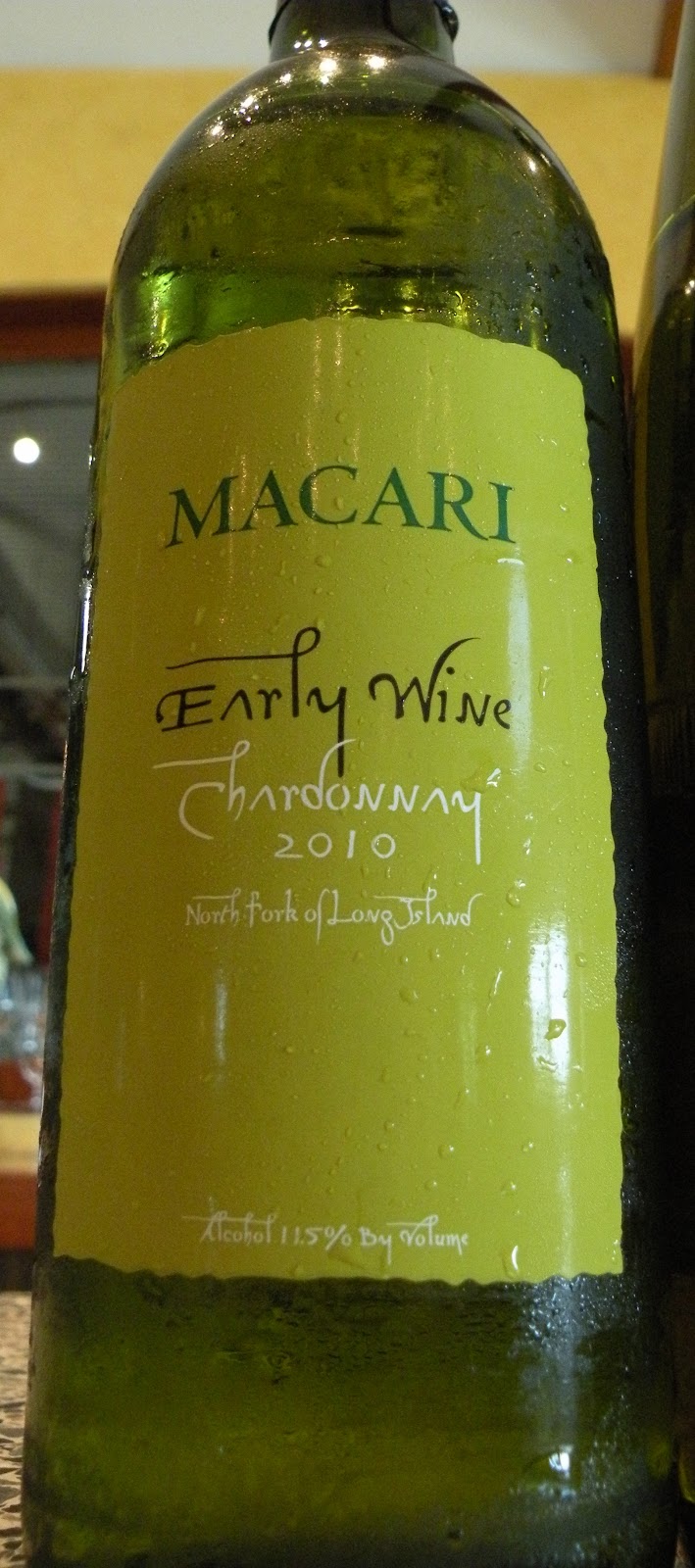
We then went back for one more Chardonnay, the 2010 “Early Wine,” which is a wine made of Chardonnay grapes picked early and sent through production to bottling very quickly.  The color is extremely pale, with characteristics of youthfulness, light citrus, melon, green apple, and white flowers, with a bit of tropical fruit on the palate, but overall the wine has very green and bright characteristics.  I liked the refreshing uniqueness coupled with the nice balance and acidity, and the very long finish.

2010 Early Wine Chardonnay

Rose is so popular this year and Macari’s 2010 Rose certainly didn’t disappoint.  It is a blend of mostly Merlot and other Bordeaux varietals, and has a beautiful salmon pink color.  The aromas include cherry (but not sour), strawberry, a hint of watermelon, and a bit of herb and stony soil.  The flavors were reminiscent of tart cherry, strawberry, and fresh watermelon, and the wine shows bright acidity and a happy sort of personality with a long finish and lovely balance.  I really enjoyed this wine very much, I believe it is quite food friendly and I look forward to its release so I can enjoy it again.

2010 Rose

And then it was time to move on to the reds.  First was the 2008 Cabernet Franc, a ruby colored wine that showed notes of berry and plum laced with smoke, spice, earth, and just a touch of oak.  Cabernet Franc is a very successfully grown grape on Long Island, and Macari’s Cabernet Franc is an excellent representation of the varietal, with its excellent balance of acidity and tannin, followed by its long finish - I loved the structure and texture of this wine.

2008 Cabernet Franc

The next red was the Sette, a nonvintage wine of about half Merlot and half Cabernet Franc, probably the two most important red grapes on Long Island.  The wine shows an Italian influence, as intended by Macari, and while I observed the ruby colored wine, the aromas leapt out of the glass to reveal a nose of both red and dark berries and fruits and fascinating spices and wood, with a warm earthiness about it.  The flavors confirmed the fruit and spice, with excellent structure and a lingering finish.  I think this is an ideal wine for the cooler months and would make a lovely pairing with meats and Italian cuisine, and as Gibson mentioned, it’s a wine perfect for enjoying by the fireplace.

Sette

We then moved on to the 2005 Merlot Reserve, which is beginning to show some age as the color is turning from red to a brick hue, and the wine’s age was evident in its fascinating complexity, with unique aromas of dark fruit, mushroom, damp earth, and a hint of spice and wood.  The flavors were very indicative of a good Merlot, including more red fruit than the aromas showed, a French sort of influence in the earthy quality, good acidity and firm tannins, and a very long and lovely finish.  This wine I would probably pair with steak or slow-cooked meats.

2005 Merlot Reserve

Next was the 2007 Bergen Road, a “Macari favorite” and for good reason - this Meritage type wine (a sort of Bordeaux blend often done very nicely at several Long Island wineries) is complex and elegant.  A deep ruby with a red-pink rim, the wine stains the glass with its intensity, and opens into aromas of seductive dark fruit and red fruit, smoke, deep spice, a bit of earth, chocolate, and wood, and lots of fruit and spice on the palate, with excellent structure and balance, a luscious texture, and a long finish.  I would love to try this wine again in a few years and see how it has developed; this wine is stunning and very impressive.

2007 Bergen Road and 2008 Dos Aguas

The last red was the 2008 Dos Aguas, another Meritage, very dark with a color similar to Malbec, deep purple with a pinkish rim indicating its youthfulness.  The aromas were of dark fruit, stewed berries, plum, and spice, and the flavors confirmed the aromas, with a bit more emphasis on the spice.  Another nicely balanced wine with a long finish, this wine would pair nicely with meats.
Finally, it was time for the 2008 Block E, Macari’s lovely dessert wine of Viognier and Pinot Gris.  The wine is a golden color, not overly viscous, with aromas of apricot, stone, honey, and a vegetal note, and flavors of apricot, peach, tropical fruit, and honey.  The wine is soft and smooth, and remarkably light for a dessert wine, significantly lighter in density than a Sauternes, for example.  I feel this dessert wine is food friendly in that it could also be paired with spicy cuisine, including Asian dishes, and not just dessert wine - or it could be paired with desserts, or enjoyed as a dessert on its own.  I have always enjoyed Block E and the 2008 is as wonderful as I remembered previous vintages.

2008 Block E

I wrapped up my visit to Macari with a lovely conversation with Mr. Macari.  I had a wonderful time at their tasting room and am looking forward to my next trip there, the wines are fantastic and Macari ranks among my favorite wineries on Long Island for their consistent good quality, beautiful vineyards and tasting room, and pleasant and knowledgeable staff.  So the next time you’re visiting Long Island’s wineries, be sure to stop in at Macari’s tasting room.


Friday, July 1, 2011

Appreciation for German Rieslings

Riesling has left me scratching my head a number of times over the years.  So many people use Riesling as their gateway or training wheels to drinking wine, and while I do realize it has those sweeter, fruity characteristics that tend to somewhat mask its radiance and acidity, I think most people who start with Riesling tend to underestimate the varietal.  Riesling isn’t just an entry level wine the way white Zinfandel is.
I knew a guy several years back, and one day he and I were discussing wine.  He was dark and handsome and very Southern Italian, and I was figuring him for the Super Tuscan type, and then he told me he really just drinks Riesling.  Now, drinking Riesling isn’t something to be ashamed of - it’s something to be proud of and happy about.  But it sounded as if he had just told me he drinks only white Zinfandel.  Riesling is not a set of training wheels, and while it’s a fairly easy wine to break in on, I think for that reason many new wine drinkers assume it’s nowhere near as special as Cabernet or Pinot Noir, for example.  Not so.
Riesling is a white grape native to the Rhine area of Germany and dates back somewhere between 500 and 600 years ago.  Over the years, Riesling has been planted elsewhere, including Alsace (France), Austria, United States (most notably in the Finger Lakes region of New York), Canada, Australia, and some other areas as well, and it tends to grow best in cooler areas.
I’ve tried Rieslings from several regions and have enjoyed most Rieslings I’ve tasted, but my favorites are often from Mosel, Germany.  In Mosel, producers tend to be purists, and the Rieslings are rarely blended with other grapes, rarely exposed to new oak barrels, and rarely treated with commercial yeast.  For those reasons, Mosel Riesling is especially indicative of its cool terroir and stony soil, and its true characteristics are able to come through to the nose and palate of the drinker.  Karen MacNeil (in The Wine Bible) goes so far as to describe the pure Mosel Riesling as seemingly “naked” and “transparent.”

Mosel Riesling with sesame seared tuna and avocado, with a sauce of lime, soy, honey, and wasabi - Riesling is generally very food friendly

Riesling, particularly from Mosel’s steep slopes, is often very pale in color and light in texture with characteristics of citrus (most notably lime), tropical fruits, bright green apple, blossoms, and of course mineral.  So many people think of Riesling as a sweet wine, but in fact it has very high acidity and is very nicely balanced, making it especially food friendly with lighter dishes as well as spicy Asian cuisine.  And as strange as it may sound, one of the things I like most about the German Rieslings I’ve tasted is that many are very low in alcohol content, making them so refreshing and easy on the palate.  Lots of Rieslings should be enjoyed while young in order to experience the fruit and floral characteristics, but Riesling also has great aging potential, particularly the sweeter Rieslings (but watch out for the petrol notes that tend to surface in older Rieslings).
Other German regions are increasing their production of Riesling as well, particularly Rheinhessen, which has generally concentrated on Muller-Thurgau over the years.
My “everyday” Riesling is the Doctor Loosen “Dr. L” Mosel Riesling, a very dependable and consistently good pale colored, light Riesling with characteristics of lime, peach, and a hint of something tropical in its fruitiness, with just a bit of spice.  The wine initially appears a bit sweet, but the acidity comes through and cleanses the palate, making this wine extremely food friendly.  I’ve tasted it with pork, seafood, chicken, turkey, lighter cheeses, spicy Thai food, and even on its own, and I’ve enjoyed it every time - and it’s a good bargain as well, at only about $10.

2008 Doctor Loosen “Dr. L” Mosel Riesling

A somewhat more textured and less dry Riesling I recently tried is the Fritz Windisch Selzer Osterberg Riesling Auslese from the Rheinhessen region.  A bit more golden in color than most Mosel Rieslings I’ve tried, this wine still has the citrus notes, but has greater emphasis on orchard fruit characteristics such as peach and apricot, and still has the floral aromas but leans a bit toward honey sweetness instead of the lighter floral characteristics.  This wine would be especially well suited for spicy Asian foods.

2009 Fritz Windisch Selzer Osterberg Riesling Auslese (Rheinhessen)

The most recent Riesling I’ve tried is the St. Urbans-Hof Mosel Riesling; this wine defines transparency, with its pale color, and fresh lime and peach characteristics and floral notes with a hint of spice and lots of minerality.  It is a perfect reflection of its Mosel terroir with a balance of sweeter fruit and racy acidity, leaving the palate perfectly cleansed.  This wine is very food friendly and so sophisticated and elegant, I was very impressed with this Riesling.

2009 St. Urbans-Hof Mosel Riesling

Due to the complexity and beauty of Rieslings as well as their aging potential, not to mention the work that goes into producing it (the slopes in Mosel are so incredibly steep, and the producers do all that they can to maintain the purity and integrity of the wine), I would hope that so many new wine drinkers stop using Riesling as their training wheels and eventually come to appreciate the wine for what it is.

Thursday, June 23, 2011

Riedel Wine Glass Tasting at Morton’s The Steakhouse

This week I had the pleasure of attending a presentation of Riedel wine glasses including a tasting of several wines, at Morton’s the Steakhouse in Manhattan.  The purpose of the tasting and presentation was to demonstrate how the use of a proper wine glass enhances the experience of drinking each particular wine.
Many people are skeptical of whether the shape or quality of the wine glass has any effect on the appearance, aroma, and flavor of the wine - in fact, the Riedel representative posed the question to the people in attendance as to whether they were at all skeptical about how a glass effects the overall wine experience.  But after a very short amount of time, it was clear that a good quality and properly shaped wine glass indeed affects the wine experience.

Riedel Wine Glass Tasting at Morton’s The Steakhouse

Since a tasting should begin with the lightest wine of the evening, the first wine we tasted was the Chateau Ste. Michelle Horse Heaven Vineyard Sauvignon Blanc, and the glass was the Riedel Vinum Sauvignon Blanc.  The glass is egg shaped and the top is a bit tapered, so that the aromas typical of Sauvignon Blanc - light fruits and flowers - are enhanced, and the wine is directed to the front of the tongue and palate, which makes the flavors and bright acidity characteristic of Sauvignon Blanc become more apparent.
We were also asked to sample the same Sauvignon Blanc from the “joker” glass, a small plastic cup which completely detracted from the aromas, and over-emphasized the acidity.  Clearly, a plastic cup is not suited for drinking good wine, or any wine for that matter.  I think that much was clear before we even began the tasting, but after analyzing the Sauvignon Blanc in its proper glass and experiencing all of the aromas and flavors one would expect from the varietal, one could already be persuaded to invest in appropriate Riedel glasses for a variety of wines.  And there were still three more wines to try, in three different glasses.
The next wine was the Chateau Ste. Michelle Canoe Ridge Estate Chardonnay, a white with more body than the Sauvignon Blanc.  The wine was served in the Riedel Vinum Chardonnay Montrachet glass, with a large bowl and a very wide rim, best suited for accentuating the wine’s fuller and more intense characteristics, including the buttery, rich, caramelized notes of the Chateau Ste. Michelle Chardonnay.  Had the Chardonnay been tasted from the narrower, egg-shaped glass, the full bodied wine would have lost its rich character.
We then moved on to the reds, the first of which was the Villa Maria Cellar Selection
Pinot Noir, with fruit characteristics and gentle tannins.  The glass was the Riedel Vinum Pinot Noir Red Burgundy, with a large bowl perfect for bringing out the Pinot Noir’s fruity aromas, and the tapered rim aiming the wine at the front of the tongue to perceive the sweeter characteristics of the wine and softening the perception of acid, making for a proper balance in the flavors and textures.  If the wine were tasted from a glass that looks similar (the Montrachet glass) but without the tapered rim, the aromas will be preserved, but the flavors will be misdirected, causing the wine to display too much acidity, and masking the fruit flavors characteristic of Pinot Noir - clearly the Pinot Noir must be tasted in a glass with the large bowl, but with the narrower rim.
The final wine of the tasting event was the Chateau Ste. Michelle Cold Creek Vineyard Cabernet Sauvignon, a tannic, full bodied red with notes of dark fruits.  The glass was the Riedel Vinum Cabernet Sauvignon/Merlot, with a deep bowl ideal for bringing out the many layers of aromas in Bordeaux varietals, that tapers to a narrower rim, again directing the wine to the areas of the mouth that detect sweetness, allowing the wine to show its fruit, instead of only displaying the tannins.
After tasting the wines in the Riedel glasses for which they were intended, it was clear that a wine enthusiast hoping to maximize the experience of the wines should invest in good quality, properly shaped glasses.  The hosts of the event were so gracious as to send their guests home with a set of complimentary Riedel glasses, one of each of the glasses we used during the tasting.  My glasses of choice are Riedel, and the glasses of the Vinum collection are relatively affordable - it is certainly worth investing in these glasses to better enjoy your wine experiences.

Riedel