Total Pageviews

Saturday, March 26, 2011

Getting Reacquainted with Zinfandel

White Zinfandel has never been for me.  And unfortunately over the years, red Zinfandel has never ranked among my favorites, either.  But, over the past year, I’ve been on a sort of mission to enjoy more wines from American producers, and with Zinfandel being one of the most important grapes in the United States, I’ve been making an effort to reacquaint myself with Zinfandel.

 
2008 Michael David 7 Deadly Zins Zinfandel
The first Zinfandel I tried more recently was the 2008 Michael David 7 Deadly Zins, a blend of Zinfandel from seven vineyards in Lodi.  The wine is extremely dark in color, and that seemed to be an indication of things to come.  Big and bold, with notes of arid earth, dark fruit, and some intense pepper and spice, I finally began appreciating the wine after allowing it to breathe for nearly three hours.  And after enjoying the wine with its fullness, intensity, and length, and pairing it with the Godiva dark chocolate and raspberry bar, the alcohol (15%) finally did me in.


2005 Rosenblum Appellation Series Zinfandel
The next Zinfandel I tried, just a few months later, was the 2005 Rosenblum Appellation Series from the North Coast.  Also deep in color, this wine displayed spiciness and dark berry, somewhat more textured on the palate than the 7 Deadly Zins, and certainly more acidic, and about the same lengthy finish.  The wine was let to breathe for at least two hours, and paired with barbecue food.  Since this wine was shared among several of us, the 14.8% alcohol didn’t wreak too much havoc.  At that point, I preferred the 7 Deadly Zins.


2003 Madrone Ridge Zinfandel
Very recently, I decided to spend a bit more and went for the 2003 Madrone Ridge Zinfandel from Sonoma, which I paired with smoked mozzarella and a sauce of creamy marinara, bison meat, sauteed portobello mushrooms, and spinach, over pappardelle pasta, and finally with a chocolate and hazelnut bark.  I allowed the wine to breathe for about two hours and I sipped it over the course of perhaps three hours.  This bold Zinfandel is a very dark red, almost black, with a reddish maroon rim, and the aromas burst out of the glass, with deep characteristics of chocolate, dark berry, earth, and cinnamon spice, and the flavors reflected the aroma well, followed by a very long finish.  I found the wine to taste and feel a bit hot and slightly sharp and fairly acidic, even after allowing it to breathe, although some of the sharpness subsided.  And by then, feeling the alcohol at 14.5% and sipping the wine alone, I still determined that my favorite was the 7 Deadly Zins, interestingly the one I paid the least for.


Thursday, March 17, 2011

Some Spanish Favorites

Listening to some fantastic flamenco music, I feel inspired to discuss some of my favorite Spanish wines.  In spite of some very high alcohol content of some of these Spanish wines, I find them to be quite approachable, very drinkable, and in fact kind of warm and welcoming.
A most unique Spanish wine I’ve come to love is a Cava, the Llopart Leopardi Brut Rose, which is a bronzed pink in color and unlike any other Cava I’ve tasted, in that it has a unique depth due to its composition of Mourvedre, Grenache, and Pinot Noir.  The Cava is full of berry and fruit, hints of citrus, and a bit of the fresh bread characteristics, with a bright acidity to accompany its bubbly texture.  Very food-friendly, I’d say this wine is sophisticated yet fun, and although it’s a bit difficult to find in wine shops, it’s definitely worth searching for.  To date, this is my favorite Cava.
For my Spanish white, I go with the Nora Albarino from Rias Baixas in the Galicia region.  Pale in color and medium-bodied, Nora displays notes of melon, peach, a bit of citrus, and a hint of spice, with some exotic tropical fruit as well.  I think this wine is excellent for pairing with seafood, and provides a nice alternative for those who are a bit too used to Chardonnay and Sauvignon Blanc.
The first Spanish red to grab my attention was the Cellar Can Blau, an interesting blend of Carinena, Syrah, and Grenache from Montsant.  Dark in color with a reddish rim, the wine’s most interesting attribute is its reflection of the wet slate in the earth where the grapes grow.  Both the aroma and the taste show the wet slate, particularly if the wine has not been exposed to the air for very long.  Also present are notes of dark fruit, spice, and a hint of smoke.  The wine has a very smooth texture, followed by a long finish.  This wine can be enjoyed with meats and traditional Spanish fare, but my preference is to drink it on its own.

2008 Celler Can Blau

One of the most memorable Spanish wines I’ve tasted is the Bodegas El Nido Clio, a blend of Monastrell and Cabernet from Jumilla.  I first tried this wine several years ago, and after trying it again more recently, it was just as wonderful as I had remembered it to be.  Very deep in color, the wine is equally deep in aroma and flavor.  Even after allowing the wine to breathe for at least an hour, it still comes bursting out of the glass with its rich smokiness, spice, and dark fruit.  After allowing it to breathe in the glass for even longer, it begins to show the presence of the Cabernet and becomes just a bit tamer.  The texture is rich and dense, and the finish is extremely long.  The wine pairs very nicely with meat dishes, otherwise it is likely to overpower the food.

2007 Bodegas El Nido Clio

The other very special Spanish red that stands out in my mind is the Torre Muga Rioja, an impressive blend of Tempranillo, Mazuelo, and Graciano.  The wine is a very dark purple, with notes of bold spice, dark fruit, and earth, with a bit of smokiness, and it tends to soften a bit after breathing.  Torre Muga is less intense than the Clio, perhaps dryer, and more structured, and the finish is almost as long.  This wine also pairs particularly well with meat dishes as it is a wine with a big presence.
To round out a Spanish dinner, try a traditional caramel flan with a good Solera.  My favorite is the Alvear Pedro Ximenez 1927 Solera, which is enjoyable paired with a dessert such as flan, or on its own, or even with a good cigar.  The wine is amber in color, with characteristics of rum raisin, caramel, nuts, and vanilla, yet it is by no means overly sweet or thick in texture, and the finish is lengthy.

Wednesday, March 9, 2011

Sparkling Pointe - Long Island Sparkling Wine

Last weekend I had the pleasure of visiting a tasting room here on Long Island that I’ve never visited before, at Sparkling Pointe in Southold.  Sparkling Pointe is the only exclusive sparkling wine vineyard in New York.  The winery is absolutely beautiful and I am sure is a lovely venue for events.  The visit to the winery was especially fun for me as I got to discuss their wines at length with Dylan, a member of Sparkling Pointe’s tasting room staff, and I must say she certainly is an asset to their winery.

Sparkling Pointe in Southold on Long Island's North Fork

Sparkling Pointe’s wines are produced in the traditional Methode Champenoise, and all of their wines are brut, and are made with the same grape types used in the Champagne region (Chardonnay, Pinot Noir, and Pinot Meunier).  I expected the wines to be good, and they didn’t disappoint - in fact, they exceeded my expectations, and I came home with a bottle of the wine I enjoyed the most.


The first wine I tasted was the 2006 Brut, Sparkling Pointe’s best-selling wine, made of Pinot Noir and Chardonnay.  The wine is pale in color with a light bouquet of fresh green apple and pear, and the flavors reflect the same fresh fruit and crispness.  In fact, the wine has a green fruit aura about it.  After allowing the wine to reach all parts of my palate, I noticed the bubbles are particularly fine.  This wine reminded me of the Veuve Clicquot Yellow Label Brut, particularly in texture.  The finesse and delicate character of this wine indicate that it would make an ideal aperitif or pair very nicely with hors d'oeuvres and light cheeses.
The second wine was the 2007 Topaz Imperial, made of Pinot Noir and Chardonnay.  This wine is uniquely beautiful in the glass - it is a very light bronzed pink, almost salmon color, I’ve actually never seen a wine quite that color.  And the wine bears resemblance to the Brut, both in aroma and taste - crisp, with green apple and pear characteristics, except there are also hints of red and pink fruit tartness on the palate, and the Topaz is perhaps more acidic than the Brut.  Also, the bubbles in the Topaz appeared a bit larger than in the Brut, and in terms of texture, this wine reminded me of the Louis Roederer Brut Premier.  For its more diverse flavors and slightly bolder texture, I would like to try this wine with a dish with a bit more substance, perhaps a seafood dish or a light poultry dish.
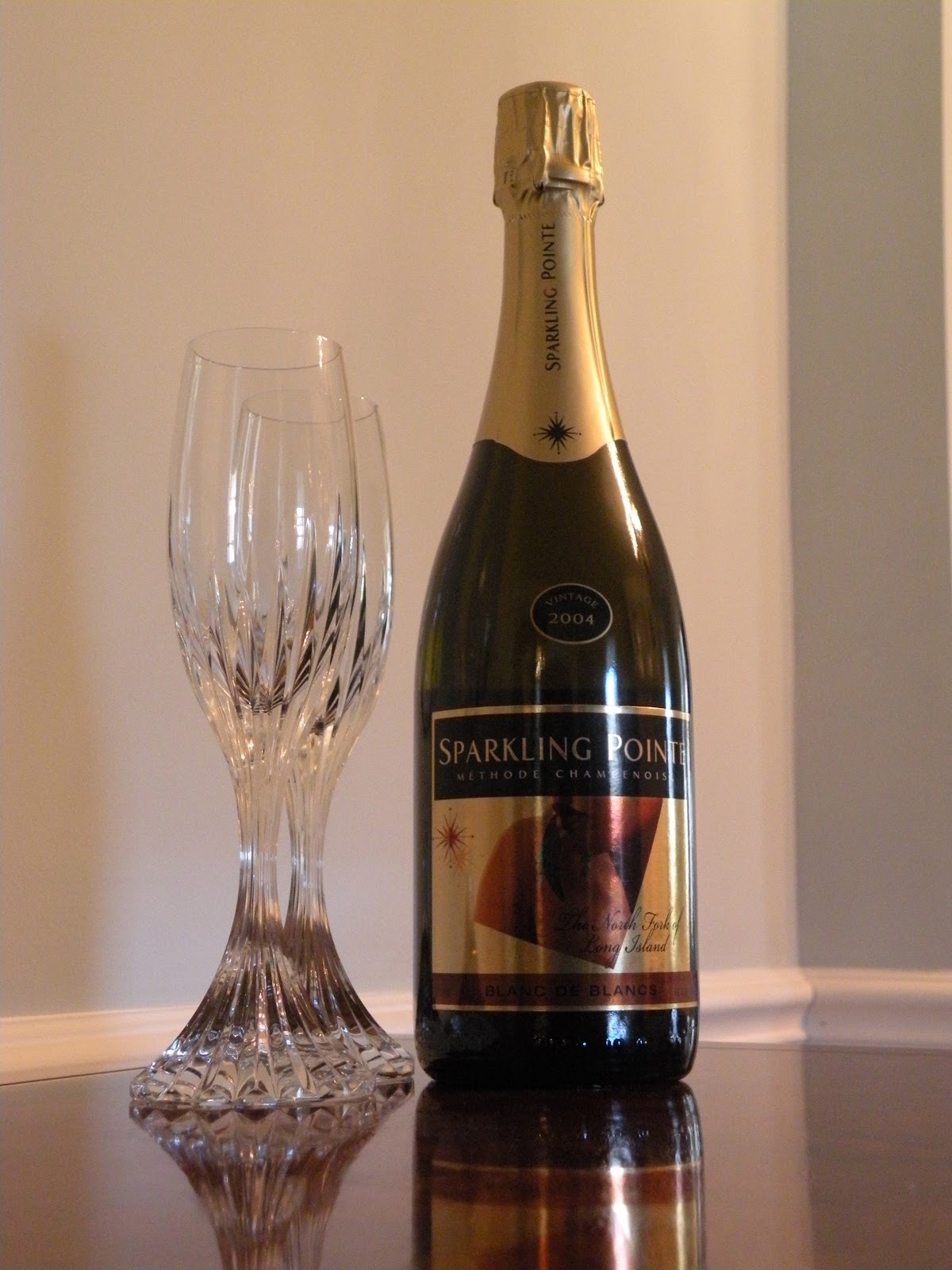
The next wine was the 2004 Blanc de Blancs, 100% Chardonnay - and this wine absolutely blew me away.  If blindfolded, I would probably guess this sparkling wine is from the Champagne region.  Gold in color and attractive in the glass, the wine was quite different from the first two - it had a more complex, much deeper bouquet, reflecting earthier characteristics, as well as baked apple and bread fresh from the oven.  I even remarked to Dylan that the wine had an aroma of warm apple pie, including that drop of lemon juice that goes into the pie.  The flavor matched the apple pie characteristics, plus notes of nut, and perhaps a bit of cheese rind.  The texture is lovely, the bubbles are very fine, and there is a bit of an elegant creaminess to the wine.  Although the wine is quite crisp and clean, it has a big presence and a lengthy finish.  For lovers of Moet & Chandon, this is your wine.  I would prefer to have this wine on its own when experiencing its many layers, but if pairing it, I would choose either a good quality brie served at room temperature, or slightly chilled fresh shellfish.

2004 Sparkling Pointe Blanc de Blancs at the tasting room


2004 Sparkling Pointe Blanc de Blancs, the bottle I brought home

The final wine I tasted was the 2001 Brut Seduction, made up of Pinot Noir and Chardonnay.  This wine is exquisite, it has an autumn gold color, with aromas of fresh bread, nut, and exotic fruits and flowers.  The flavors include nut and baked bread and a bit less fruit.  The bubbles are extremely fine, and the finish has some length, although not quite as long as the Blanc de Blancs.  I would like to try this wine most likely with hors d'oeuvres or on its own as an aperitif, it is quite lovely and a bit lighter than its color would indicate.

2001 Sparkling Pointe Brut Seduction

Overall, I was very happy to enjoy each of the four wines I tasted and I would go for a bottle of any of them again.  My favorite was the 2004 Blanc de Blancs, and that was the wine I chose to bring home, and it now occupies the most recent spot in my wine rack.  So if you’re spending some time on Long Island, I highly recommend a trip to the North Fork and a visit to the tasting room at Sparkling Pointe.


Wednesday, March 2, 2011

Jordan Vineyard & Winery

A few months back, I was out to dinner with the family at one of our all-time favorite restaurants, The Country House in Stony Brook right here on Long Island.  The Country House, owned and managed by our very dear friend Bob Willemstyn, is a lovely restaurant with elegant cuisine, a fabulous wine list, and beautiful decor, and over the years has made important events for our family all the more memorable.
On this particular evening, I got to try four new wines and enjoyed them all, but the one that stood out most to me was the 2005 Jordan Cabernet.  The wine was first paired with steak au poivre and then I enjoyed it with a decadent chocolate dessert.  The wine is a rich and deep maroon/purple with a slightly lighter rim, and the color reflects the aromas and flavors, which display characteristics of dark fruits and berries and currant.  There is a hint of spice with a modest presence of vanilla, indicating the use of both French and American oak.  This wine is wonderfully balanced and fills the palate without being overpowering, making it rather food-friendly, particularly for meat dishes and chocolate desserts.  The finish is very long and memorable.  Since that evening, this wine has become one of my favorite Cabernets.  I have tasted the 2002 and 2005 vintages and am hoping to try the 2006 before long.  I will mention that the 2002 was given nearly two hours to breathe in a decanter, while the 2005 was given perhaps a half an hour, and I think the two hours did the wine a great deal of justice (on that evening it was paired with Beef Wellington).  Jordan Cabernet appears to have great aging potential, so of course we keep some in our wine rack and somehow resist the temptation to open them right away.

2002 Jordan Cabernet

Months later, back at The Country House for another lovely dinner, I had the opportunity to try the 2008 Jordan Chardonnay, with Maryland crab cakes.  The Chardonnay is excellent - it has a lovely pale straw color indicative of its clean, crisp texture.  The well-balanced wine hints at fruits green and white in color, namely green apples, pear, and white peach, with a long finish that leaves the palate clean and ready for another bite of your meal and another sip of the Chardonnay.  I think the wine would pair very nicely with a shellfish or seafood dish, or a light chicken dish.  Recently it seems Chardonnay is a bit out of style, perhaps because so many are the same as the next, and perhaps because some are over-oaked.  But I believe Jordan can bring a disgruntled wine drinker back to Chardonnay - in my opinion, it’s everything a California Chardonnay should be.

2008 Jordan Chardonnay

Friday, February 25, 2011

Sauvignon Blanc - Vive la France!

I’ve noticed in the past year or so that fewer and fewer people are going for Chardonnay and Pinot Grigio and more are picking Sauvignon Blanc.  But everyone seems to be reaching for New Zealand Sauvignon Blanc (and I myself happen to like Oyster Bay, Kim Crawford, Matua, and Monkey Bay, to name a few).  And there are some American Sauvignon Blancs I enjoy, namely the lovely herbal Raphael Sauvignon Blanc from the North Fork of Long Island, and the clean and very affordable Rock Rabbit Sauvignon Blanc from the Central Coast of California.


But my favorite Sauvignon Blancs are often from France, from the Loire Valley in particular.  On opposite sides of the river are Pouilly-Fume and Sancerre, with some of the most wonderful Sauvignon Blancs in the world.  The white wines produced here are smoky, crisp, and dry, and generally lovely, as well as being quite food-friendly.
A very nice example of Pouilly-Fume is the Domaine Alain Cailbourdin Les Cris.  This was the white wine chosen by my sister for her wedding.  It was a very good pairing with the swordfish entree and it was a perfect pairing with the appetizer which was a chilled lobster sampler.  The wine is light and crisp and classy yet energetic, with notes of citrus and white fruits and herbs with mineral characteristics, and has a lengthy finish.  Unfortunately, the wine is not particularly easy to find in wine shops, but if you can locate it, I highly recommend it.

2008 Domaine Alain Cailbourdin Pouilly-Fume Les Cris

I’ve been very fortunate to try a few excellent wines from Sancerre, and my favorite is the Domaine Hippolyte-Reverdy.  The first time I tried this wine, I paired it with lobster and goat cheese, and it was an ideal pairing for sure.  The wine is light in color, and has a beautiful floral bouquet straight from the bottle to the glass, and once it opened up a bit, the exotic fruits became apparent, along with the expected mineral characteristics.  The wine is complex, smooth, and elegant, and the finish was a bit longer than anticipated, which I enjoyed, since I love this wine so much.  And after each taste, I felt compelled to go back for more, as the wine continued to change and demonstrate a whole repertoire of lovely flowers and fruits, while maintaining its cleanliness.  And I am happy to report that this wine is fairly easy to spot in wine shops, and with its beautiful label, it’s hard to miss.  If you love Sauvignon Blanc, this wine is a must.

2009 Domaine Hippolyte-Reverdy Sancerre

Friday, February 18, 2011

A Pioneer in Champagne

I just finished a fantastic book by Tilar Mazzeo, The Widow Clicquot: The Story of a Champagne Empire and the Woman Who Ruled It.  The book was entertaining and informative and a must-read for anyone who loves Champagne.

The Widow Clicquot: The Story of a Champagne Empire and The Woman Who Ruled, It by Tilar Mazzeo,  accompanied by a bottle of Veuve Clicquot Ponsardin Yellow Label Brut NV

Veuve Clicquot Ponsardin, my favorite Champagne producer, rose to greatness under Barbe-Nicole Clicquot Ponsardin in the years following her husband’s death.  The winery came to her through marriage to Francois Clicquot, and at the time, Madame Clicquot was only 27 years old and the winery was quite small, but her natural ability with business and her talent with winemaking, and above all, her strength even in times of desperation and nearly insurmountable challenges brought her winery to great success.
Madame Clicquot is credited with the development of “riddling.”  When the bottled Champagne has aged, the sediment must be accumulated and removed.  At this time, the bottles are placed on racks with angled holes in them, with the cork facing downward.  The bottles are regularly turned and shaken and the sediment continues to accumulate in the neck of the bottle.  This process, known as riddling, was developed by Madame Clicquot for a more efficient way of removing the sediment from the bottles of sparkling wine.  Today, only Prestige Cuvees of Champagne are made with manual riddling, and the rest are made using a mechanized riddling.  The development of this process is what placed Veuve Clicquot ahead of the competition in producing and consequently in reaching the consumers.
The Widow Clicquot is a woman to be admired, not just for her business savvy and for defying the odds during a tumultuous time for France, and as a woman guiding a large and important business in what was still a men’s world, but also for her generosity with her family and the people of Reims.  Behind the sharp woman of business was a kind hearted lady.
Barbe-Nicole Clicquot Ponsardin truly paved the way for other women to play a major role not just in the wine industry but in all areas of business, and for that, many of us are forever grateful.
As for the lovely sparkling wine of Veuve Clicquot, from the radiant and affordable Yellow Label Brut NV to the extraordinary La Grand Dame, the Champagne of Veuve Clicquot is spectacular.
Yellow Label Brut NV is a regular around our house.  A very pale sparkling gold in color, the wine displays characteristics of white fruits and green apples and a bit of sweetness, with hints of slight smokiness, excellent balance, a clean texture with such fine bubbles and assertive presence, with a long and wonderful finish - it’s all that a Champagne should be.  My favorite pairings are brie with lingonberry dressing, fresh crabmeat, and chilled lobster.
So, the next time you toast with a flute of Veuve Clicquot, please remember the lady who made it all possible.


Wednesday, February 9, 2011

Beneficial Diseases?


It still amazes me how some diseases can be beneficial in winemaking, that is, if they’re properly understood and used to the winemaker’s advantage.  The two I’m thinking of, responsible for some of my favorite wines, are commonly known as “noble rot” and “dead arm.”
“Noble rot,” very briefly and without getting too technical, is a form of the fungus Botrytis cinerea, which occurs in damp conditions.  The infection generally affects already ripened grapes, and after the grapes become raisined, the process of drying is the noble rot.  The flavors become concentrated, and the wines become sweet yet balanced with proper acidity, and some of the better known examples include Sauternes and Tokaji.
Some of my favorite wines are French Sauternes.  Sauternes, from Bordeaux, and consisting of Semillon, Sauvignon Blanc, and Muscadelle, are often regarded as dessert wines, due to their sweet taste.  As for me, I tend to enjoy my Sauternes with an appetizer of pan seared Hudson Valley foie gras, as foie gras is a classic pairing for the sweet golden Sauternes.
My most recent experiences with Sauternes include the 2003 Castelnau de Suduirat and the 1998 Chateau d’Arche.
The 2003 Castelnau de Suduirat, absolutely golden in color and a bit on the syrupy side, displays the expected characteristics of sweet orange and apricot with just a hint of wood.  The wine is slightly less balanced than I thought it would be, due to its lack of acidity, and it is also slightly lacking on the duration of the finish.  WHile the wine was paired with a pan seared foie gras, it did purport to be more of a dessert wine due to its sweetness and thick texture.

2003 Castelnau de Suduirat Sauternes

The 1998 Chateau d’Arche, a Second Cru Classe and also made up of Semillon and Sauvignon Blanc, is a bit more food friendly than the Castelnau du Suduirat.  It is also a lovely golden color, as expected, with a floral and fruity aroma that is quite exotic and lovely, and flavors of peach, apricot, sweet orange with a hint of zest, light nuttiness, tropical fruits, and natural honey.  The texture is so smooth and luscious, and the finish is respectable.  This was also paired with foie gras, and appears to be a good choice for the appetizer, as opposed to dessert, based upon its good balance of sweetness and acidity.

1998 Chateau d'Arche Sauternes

The other disease that comes to mind which affects wine and can bring about a positive result is “dead arm,” also known as grape canker.  Dead arm, unlike noble rot, affects the wood of the vine, whereas noble rot affects the grapes directly.  Dead arm occurs when two fungi, Eutypa lata and Phomopsis viticola, cause a disease to rot the wood of the grapevine, which causes one or more arms of the vine to die.  This allows the grapes growing on the healthy arms of the vine to intensify, producing a rich flavored wine.
d’Arenberg, a winery in McLaren Vale, South Australia, produces an excellent Shiraz known as The Dead Arm for this very reason - the grapevines are affected by the disease, causing the grapes on the healthy arms of the vines to intensify.  Dead Arm Shiraz is a wonderful wine, made entirely of Shiraz from the affected vines.  It is very deep in color with a more ruby rim, and displaying characteristics of rich fruit, spice, earth, and warmth, and the full, bold wine occupies the entire palate until it winds down with a long, spicy finish.  Bold and fruit forward though it is, The Dead Arm is a distinguished and elegant Shiraz with excellent aging potential.  In our household, the pairing is Beef Wellington, cooked medium.  This wine will probably always be one of my favorites.

2005 d'Arenberg The Dead Arm Shiraz